
February 2012

News: DearEditor.com Goes Mobile

Dear Readers…

Now you can access DearEditor.com on your iPhone or other mobile device. Go ahead, try it out. And if you’re a social media hipster, you’ll be glad to find DearEditor.com now on Google+ sharing industry news, creative inspirations, and writing tips to keep you in the publishing know.

Thanks to Theresa Stanton at blogsforphotogs.com, DearEditor.com is now mobile-friendly. With the new mobile design, you can easily read new posts and comments on your mobile device of choice, and you can post your own comments on-the-go. With a simple click on the arrow at the top of your mobile display, you can access archives, categories, and any page on the DearEditor.com website.

DearEditor.com is also pleased to announce the DearEditor.com Google+ page, which complements the DearEditor.com Facebook page and the @Dear_Editor Twitter feed.

Happy writing!
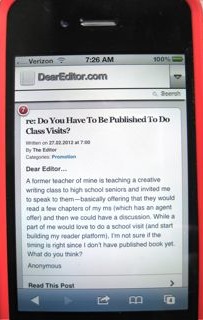
Do You Have To Be Published To Do Class Visits?

Dear Editor…

A former teacher of mine is teaching a creative writing class to high school seniors and invited me to speak to them—basically offering that they would read a few chapters of my ms (which has an agent offer) and then we could have a discussion. While a part of me would love to do a school visit (and start building my reader platform), I’m not sure if the timing is right since I don’t have published book yet. What do you think?

Anonymous

Dear Anonymous…

First, congrats on the offer. Second, visit the class. It’ll be great experience for you. When you do have a published book, you can do another visit with that teacher’s class—which will be full of entirely different students anyway. No need to turn down this opportunity because the book isn’t pubbed yet. You can expose this group to the writing/publishing process and to your work . . . and it would sure be inspirational to them. Bonus: You would get in some presentation practice when the stakes don’t feel so high. You’ll have plenty of events in the future for which you’ll worry about having books on hand; for now, get your speaking feet wet in a friendly setting.

Happy writing!
The Editor


Announcing DearEditor.com’s Revision Week, March 5-10!

/

Dear Readers…

The Editor is thrilled to host eight prolific, bestselling, award-winning authors for a week of revision tips, insights, and stories from the trenches. Learn from writers who turn first drafts into lauded books every day—and enter the daily drawings for Free Partial Edits and the grand prize Full Manuscript Edit giveaway.

Read on for more…

Mark your calendar for a week of free edit giveaways and revision talk with these talented and generous authors:

Henry Winkler, Lin Oliver, and Theo Baker, popular chapter book collaborators. Henry and Lin collaborated on 17 books in the Hank Zipzer Series and now pen the Ghost Buddy series together. Lin and Theo are the creative duo behind the new Sound Bender series. And Lin has flown solo with her Who Shrunk Daniel Funk? series.

R.L. LaFevers, author of the 13 novels for young people, including the popular middle grade series Theodosia Throckmorton and Nathaniel Fludd Beastologist, and now the forthcoming His Fair Assassin YA trilogy.

Mark A. Clements, horror/suspense author, screenwriter, and prolific ghostwriter. All of his novels have been optioned for feature films.


Kathleen Krull, author of more than 60 books, especially picture books and biographies for young readers.


Cynthia Leitich Smith, bestselling YA gothic novelist, picture book writer, short story writer, and popular children’s lit blogger.


Nathan Bransford, top blogger and former literary agent-turned-author of the Jacob Wonderbar middle grade books.


Please join us!

Multiple Character Quests

//

Dear Editor…

I’m new to writing and currently working on a YA book.  I have three main characters in my book that will be going on different quests.  How should I handle each quest in one book or should they each have a book of there own – meeting up at the end?  Thanks for you help!

Kathi

Dear Kathi…

Not one to take the easy path, eh? Try some tactics authors use when they have two protagonists with separate storylines for much of the book: 1) Give the characters equal screen time, with their chapters appearing in a regular sequence. 2) Keep the chapters short so readers won’t think you’ve abandoned a character for too long. 3) Transition out of one character’s chapter and into another with a common element. For example, end a chapter with Character A climbing onto a bus with resolve, and start the next chapter with Character B climbing down from her treehouse with resolve. This will create a sense of continuity. You don’t want readers feeling like you’re jumping from character to character.

Happy writing!
The Editor

Pitching a Collaboration

Dear Editor…

A friend and I are considering submitting a collection of our poems for publication. We have each written about half the poems. How do we handle this in our query? We each have some publishing credits for our poetry.

Sincerely,
Rosi

Dear Rosi…

Craft the first 2 paragraphs of your query letter as if your project had a single author. Pitch the hook for the collection and your interest in that particular editor/agent in the first paragraph, go into themes and topics of the collection in the second paragraph, then explain your co-authorship in the third paragraph: “This collection is a collaboration of Rosi X and Jane Doe. Rosi X is a published poet, with work appearing in [whatever]. Jane Doe is… We’ve each contributed half of the poems in the collection, and we plan to work together to support and promote this collection. Learn more about us at our websites [list sites].” Adapt that for your circumstances, of course. Both of you sign the letter.

Happy writing!
The Editor

Bumping Up My Word Count

Dear Editor…

My MG is around 20,000 words. Too long to be a chapter book and too short to be in the ideal range for MG… so do I cut and change the vocabulary to make it a chapter book or do I try and expand on the characters, add scenes, to make it more like a solid MG?

Thank you!
Franziska

Dear Franziska…

It’s unlikely that the plot, themes, and characters you designed to sustain a novel-length story are a good fit for a chapter book. Chapter books are written for a very specific audience (6- to 10-year-olds transitioning from beginning readers, with a sophistication level far below typical MG fare) and are rarely one-off books like your single title would be. The chapter book market is dominated by series. Look to flesh out your scenes, and consider adding depth to your setting. But don’t pad for the sake of padding, as you may torpedo your pacing and tension. The Newbery Medal-winning The Midwife’s Apprentice is just 22,000 words. Sometimes a short novel is a short novel because it’s supposed to be.

Happy writing!
The Editor

News: eBook Winner; Free Online Workshop with the Editor

//

Dear Readers…

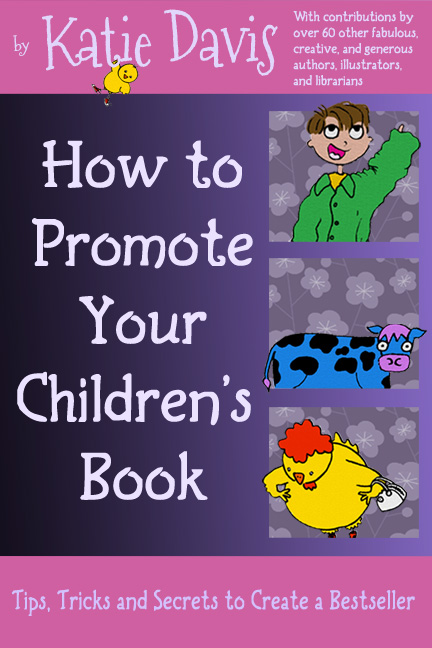
DearEditor.com is happy to announce the winner of the How to Promote Your Children’s Book eBook Giveaway, along with details about a free online YA Fiction workshop with The Editor.

Free online YA Fiction workshop with The Editor: Feb 21, 22, & 23 on the Institute of Children’s Literature website. The drop-in Q&A-format workshop takes place on the ICL’s message board, which anyone can read (no registration required). If you want to post a question, you do need to register (for FREE) by sending email to jan.fields@forums.institutechildrenslit.com with the username you want. Check out the ICL’s Guest Speaker archives while you’re there.

How to Promote Your Children’s Books eBook Giveaway winner: Julie K.

For more chances to win How to Promote Your Children’s Books, visit other stops on Katie Davis’s blog tour:

Also, check out Katie’s podcast “Promoting Your Book” (with a guest appearance by The Editor). Episode description here: http://katiedavis.com/how-to-promote-your-book/. Or click here to hear it directly.


Blog Tour: Katie Davis on Promoting Books (Book Giveaway!)

///

Dear Readers…

Author/illustrator Katie Davis is a tireless promoter whose 9 children’s books have sold over 250,000 copies. Today at DearEditor.com she’s sharing what she’s learned about promoting—and she’s giving away a free download of her new eBook How to Promote Your Children’s Book: Tips, Tricks and Secrets to Create a Bestseller.

What I love about Katie Davis is how she can make even hard work fun. This attitude is on full display in her new eBook How to Promote Your Children’s Book: Tips, Tricks and Secrets to Create a Bestseller, 30 chapters of practical advice about things like plotting your strategy, using social media, growing your mailing list, and using videos in ways beyond book trailers. I edited the book (disclaimer!), so I know there’s great info in it, from Katie as well as the 60 authors she interviewed for the book. Katie visited DearEditor.com as a Guest Editor last year to sort out the benefits of podcasting versus adding video to your website. Today she answers readers’ questions (and my own) about promoting books. At the end of the Q&A are instructions for entering a drawing for A FREE PDF DOWNLOAD OF HER BOOK.

Katie, you’ve got a lot of on-going promo tools such as your weekly podcasts. When you have a new book coming out, how far ahead of your pub date do you start book-specific promoting?

My mind can wander, imagine, plan and think of specifics while I’m finishing up the art (not the writing—I can only think of the story when I’m writing). With Little Chicken’s Big Day, every time I had a new idea, I added it to The List. Then once I turn in the art I can pay attention to that list, anywhere between 18 months to a year before the book comes out.

How do you balance your writing and promoting time?

Last year I did not do well on the balance thing! So far this year I am getting up early, doing a little social media action over coffee, and then I turn everything off and write in the mornings until lunch. After lunch I do other kinds of things, like my podcast or email answering, blog writing, etc.

Will the promotional strategies in your book work for novels, too?

Actually, it would work for any kind of book—including adult books. And in fact, the basic principles would work for any kind of promotion, though the examples are specific to children’s books.

And now a few questions from DearEditor.com readers…

I love your trailer for Little Chicken’s Big Day! What’s one effective way to use a trailer? —Anonymous picture book writer

One? Just one? Sorry. Can’t do that! Here are many things to do with your great book trailer:

  • Upload it to YouTube (you can use up to four different titles in order to upload four times, broadening your reach)
  • embed on your site
  • upload to other video sites like teachertube.com, booktrailersforall.com, and kidlitbooktrailers.ning.com/video
  • include the YouTube URL in your signature
  • create a QR code and include it on your business card
  • enter it in trailer competitions like the Moby or SLJ Trailee Award contests

Does it make sense to send free promo copies directly to teachers, as a contribution to their classroom libraries?BrickToyNut, MG fantasy writer

It would certainly be nice of you! It makes sense if you want to thank a particularly supportive or helpful teacher. However, if your goal is to generate word of mouth in the teaching community, I’d recommend holding a giveaway. Then tweet, blog, and Facebooking it to teachers would be far more effective. If your goal is to generate sales, it might be better to send support materials to tempt them to use the book in the classroom. You could do other things to be helpful, like offer “value added” services to make it worthwhile to purchase your book. Offering a free Skype Q&A to the class after they do an author study would be a great example of that. To connect with teachers for this kind of promotion, check out http://skypeanauthor.wetpaint.com/ or http://www.katemessner.com/authors-who-skype-with-classes-book-clubs-for-free/.

How important is it to create a teacher’s resource guide to go along with the book?BrickToyNut

It depends on the target age of your reader. Picture books should have activities or puzzles, or anything that extends the impact and value of your book. Middle grade and young adult novels should absolutely have a resource guide. You can offer it as a digital download on your site and other sites that sell your book, and if you have it printed you can make it available at book fairs, festivals, and school visits. I have one for a middle grade novel I wrote that did not do well, but I’m glad I have it because the teachers I’ve given it to love it!

Out of the many suggestions you have on how to promote a book, which one would you say has the highest success rate?Kurt Chambers, YA fantasy writer (whose first novel, Truth Teller, pubbed last week!) 

Congrats on your debut!

Genuine reciprocity is the best way to live online. It’s the thing I emphasize most in How to Promote Your Children’s Book. That means:

  • give before you get
  • support others
  • follow blogs not because you hope they’ll review your book but because you like what they have to say
  • engage in your community and connect

What does that look like?

  •  Tweet someone’s blog post because you like it
  •  Tell others about a great site
  •  Blog about something that will help other people

I wanted to make this tour worth it for anyone who would help me so I bribed enticed my hosts to join in the fun work by gifting them their own copy of the book. There is also promotion for them because they’re each linked on every blog I’m visiting, as well as on my own site. As hokey as it sounds, the thing that works best for me is to always try to give more than I get. It feels good to help others and if it feels good, you’ll be more likely to keep up with your promotional efforts, too.

How to Promote Your Children’s Book: Tips, Tricks and Secrets to Create a Bestseller: PDF / For kindle / For Nook /For iPad, iPhone, iPad, iPod touch

Follow Katie’s blog tour for more promo insights & giveaways:

GIVEAWAY: Leave a comment on this post by midnight Wednesday, Feb 8, to be included in the random drawing for a free pdf edition of How to Promote Your Children’s Book: Tips, Tricks and Secrets to Create a Bestseller. Winner to be announced Thursday, Feb 9.

Katie Davis has published nine books and appears monthly on the ABC affiliate show, Good Morning Connecticut, recommending great books for kids. She produces Brain Burps About Books, a podcast about kidlit, a blog and monthly newsletter. Katie has volunteered in a maximum-security prison teaching Writing for Children and over the last dozen years has presented at schools and writing conferences. She’s a 2010 Cybils judge and has also judged the Golden Kite, smartwriters.com, and Frontiers in Writing awards. Recently Katie was selected to be on the Honorary Advisory Board for the Brooke Jackman Foundation, a literacy-based charity. For more about Katie and her book, go to www.KatieDavis.com.

Bad Idea to Post Excerpts Online?

Dear Editor…

I’d like to post a 1- to 2-page excerpt of my latest manuscript along with a summary of the book on my blog. Do editors and agents frown on having the material out there for all to see before they’ve had a chance to sell it? Should I worry about the idea getting swiped before I publish it?

Sincerely,
Heather

Dear Heather…

Editors and agents don’t care if a few pages are out there when you’re submitting. After you’re signed up, though, they’ll probably want the material pulled down because you’ll be revising it. You can re-post the final excerpt on your website/blog to help you promote the book when pub time comes. As for people stealing your idea pre-pub, it happens. Heck, people will steal your entire identity online, what makes you think your intellectual property is safe? I’m not a fan of posting pre-published material for that very reason. You can likely prove you had the idea first by using blog dates and the like, but why would you want to put yourself in the position to have to fight that fight?

Happy writing!
The Editor